Archive for December, 2021
Coralmania 2021 plants coral reefs
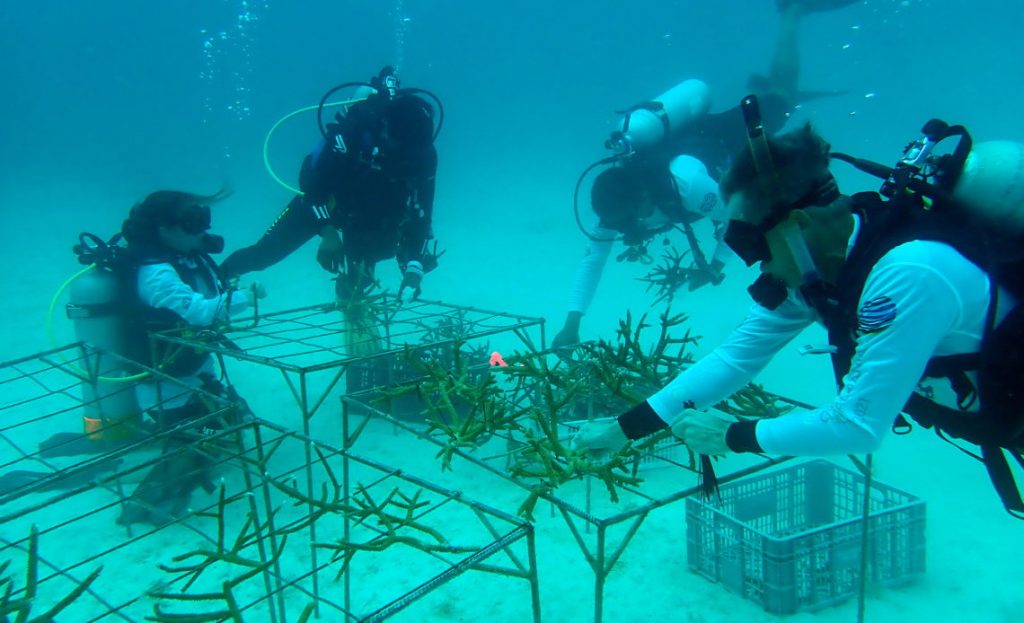
The ministries of Environment and Economy, the German Development Cooperation Agency (GIZ) and dozens of scientists, government officers, environmentalists, and tourism sector representatives have joined forces for the Coralmania 2021, the largest massive coral transplant exercise in the Central American and Caribbean region. This December, three countries (Costa Rica, Honduras and the Dominican Republic) are simultaneously carrying out coral planting efforts as part of the “Transfer of Innovative Tools for the Conservation and Restoration of Coral Reefs Program.
Olaya Dotel, deputy minister for international cooperation at the Ministry of Economy, said Coralmania is a great opportunity to build an experience that can grow and become policy for the restoring of coral reefs.
German Ambassador Volker Pellet highlighted the importance of the triangular project that unites Costa Rica, Honduras and the Dominican Republic for the conservation and restoration of biodiversity and coastal protection in the region. “It is about protecting the natural beauty of the world, that you have in the Dominican Republic, Costa Rica, and Honduras,” he said.
The German Development Cooperation, GIZ, and dozens of scientific, governmental, environmental and private institutions from the tourism sector have joined forces for the Coralmanía 2021, the largest massive coral transplant in the Central American and Caribbean region. The effort seeks to conserve and restore biodiversity and coastal reefs.
The regional goal is to transplant at least one square kilometer of coral reef, that is, more than 1,800 fragments are being placed in their natural environment to reintegrate with the ecosystem.
In the Dominican Republic, national expectations were exceeded when 372 fragments and 420 meters of coral were transplanted in 20 tables of one square meter, with the participation of more than 25 volunteer divers.
Deputy Minister Dotel, highlighted the importance of the multi-stakeholder alliance for coral restoration and said that having the opportunity to begin to repay the debt we have with our coral reef is fundamental, especially in small island countries like ours that are in the path of hurricanes.
The species selected for the regional transplant are Acropora cervicornis, Acropora palmata, and Pocillopora spp.
The triangular cooperation initiative was approved in 2019, through the Regional Fund for Triangular Cooperation in Latin America and the Caribbean on behalf of the Ministry of Economic Cooperation and Development of the Federal Republic of Germany. It aims to promote the conservation and restoration of coral reefs in the three nations, through the transfer, exchange, and consolidation of experiences and tools.
In the Dominican Republic, it has the support of the GIZ, the participation of the Vice Ministry of International Cooperation of the Ministry of Economy as the lead agency for cooperation in the country, the Ministry of Environment as counterpart entity, as well as Fundemar, with the support of the Ecosystem-based Adaptation project, financed by the Caribbean Biodiversity Fund, the Puntacana Group Foundation, the Cap Cana Foundation and The Nature Conservancy.
Rita Sellares, executive director of Fundemar explained: “The key to a successful and replicable restoration program is to adapt existing technologies and customize these to the reality of each country, the conditions of the site where it will be implemented, and the technical and economic capacity of the institution. As well as the key alliances between the private sector, NGOs and government agencies, the commitment of the local community, the creation of job opportunities and training to become technicians in coral restoration creating a self-sustainable program”.
Deputy Minister Dotel thanked the government and the people of Germany for this initiative and others being developed in the country. “Germany has its sights set on the environmental issue and has been accompanying us through GIZ in learning and acquiring new practices”.
Meanwhile, Yeralffi Arache Ruiz, Eastern Regional Coordinator of the Ministry of Environment, speaking on behalf of José Ramón Reyes, Vice Minister of Coastal and Marine Resources, expressed his joy for this type of collaboration in favor of these ecosystems and thanked the support received by the German government, through the GIZ, and also valued the extraordinary work being done by Fundemar, the Dominican maritime protection agency.
Source: DR1, N Digital
Dec 16, 2021
Puerto Plata becomes the only city in the Caribbean with two tourist cruise ports

PUERTO PLATA.- With the inauguration of the new Taíno Bay tourist and cargo terminal, Puerto Plata becomes the only town in the Caribbean with two ports for tourist cruises.
This work, with the investment of more than 80 million dollars at the first stage, was built through a public-private alliance by the Mexican capital company ITM Group represented by the Puerto Plata Port / Investment Inversiones Mahahual consortium. The main executive of Taíno Bay, Mauricio Hamui, defined this port as a great work of infrastructure where docks, fillings, dredging, and piles were made at more than 40 meters depth in record time, thanks to the efforts of a team of hardworking people who worked 24 hours a day non-stop to make this tourist terminal a reality.
The President of the Republic, Luis Abinader, when leading the opening ceremony, said that the Taíno Bay tourist pier means the generation of thousands of direct and indirect jobs that will continue to create decent income for Puerto Plata and the surrounding communities. At the same time, the president highlighted the historic arrival at the new tourist terminal of Puerto Plata of the first cruise “MSC Seashore” with more than 1,700 tourists from Miami, the United States.
The new Taíno Bay pier has three docking positions and a passenger reception center with a capacity to accommodate about 14 tourists simultaneously. The facilities have tour sales services for tourist spots in the city, recreational areas and restaurants, shops, and all kinds of services, as well as service centers in each area and warehouses, as well as spaces for the proper treatment of waste.
Source: Puerto Plata Digital
Dec 16, 2021
France to finance monorails for Santiago and to Las Americas International in Santo Domingo
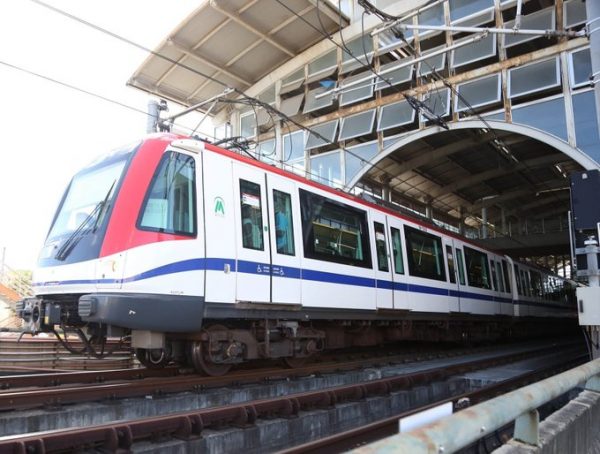
France will help finance the construction of mass transit urban mobility solutions for the city of Santiago, the second largest in the Dominican Republic, and from 27 de Febrero in the capital city to Las Americas International Airport in eastern Santo Domingo.
Minister of the Presidency Lisandro Macarrulla signed the agreement for the Dominican government. Visiting French Minister Delegate for Foreign Trade and Economic Attractiveness, Franck Riester, represented the French state.
The works are included in a bilateral agreement that commits both countries to work together for the development of the mass transportation network of the cities of Santo Domingo and Santiago de los Caballeros. French technology already powers the Santo Domingo Metro.
The agreement calls for French companies to provide technical and financial cooperation to continue to develop the mass transportation systems in the Dominican Republic. It also provides for the construction of the new monorail project in the city of Santiago and the metropolitan train to Las Americas International Airport in eastern Santo Domingo.
The French Development Agency will also be lending EUR86 million to double the length of the Santo Domingo Metro trains on line 1 (lengthening from 3 to 6 cars), to transport around 66,000 additional passengers per working day on this line and, consequently, reduce waiting lines at peak hours.
The contract is part of an overall strategic framework formalized in the 2021-2023 Cooperation Roadmap between the French Development Agency (AFD Group) and the Dominican Republic for technical and financial cooperation
The Office for the Development of Urban and Interurban Mobility Projects, which reports to the Ministry of the Presidency (MINPRE), is in charge of monitoring and implementing these projects.
The signing took place during France Week in the Dominican Republic.
Source: DR1, El Dia
Dec 10, 2021
Presidency strikes a deal with Samaná road concessionaire
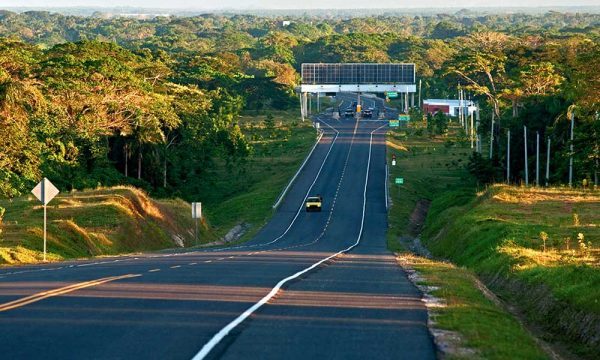
The Autopistas del Nordeste concession for the Las Americas Highway to Samaná road and the coastal road to Las Terrenas is now revoked. President Luis Abinader made the announcement in a televised address on the evening of 9 December 2021. The concession was due to expire in 2038.
The contracts for these roads signed during past governments (Leonel Fernandez and Hipólito Mejía) made the road the most costly ever built in the Dominican Republic. A road estimated to have cost US$125 million to build ended up being billed to the Dominican government for 25 times more due to an infamous shadow toll clause.
The government had budgeted RD$4.65 billion to pay for the shadow toll in the 2022 National Budget. The contract stipulated a minimum number of vehicles that would use the road per month. When this was not met, the shadow toll clause required additional compensation from the state.
During the address to the nation on Thursday, 9 December 2021, President Luis Abinader said an amicable agreement had been reached for the termination of the concession contract for the Samana toll road.
The toll road cuts the driving distance by approximately two hours. It is also regarded as one of the most dangerous roads in the country and requires drivers to keep to speeds of 80 km and 50 km in the stretch that crosses the Haitises National Park with its many pronounced curves for safety reasons.
President Luis Abinader says the agreement translates into savings for the government of approximately US$1.5 billion.
“The agreement we announce today establishes the state will pay US$410 million to terminate the concession contract. This amount is approximately what we would have had to pay for shadow tolls in the next four years and four months, not counting what the tolls would generate once they have been transferred to the state trust RD Vial,” said the President in making the announcement.
He said that effective 1 January 2022, tolls would drop 20% on the Las Américas tolls road to Samaná road. “There will be savings for the coffers of the state and for the pockets of Dominicans,” the President said.
The contract dates back to a first signing in 1999 (Leonel Fernandez government) when a Colombian company received the road concession. Amendments of the contract would be signed by former ministers of Public Works Miguel Vargas Maldonado (Hipolito Mejia government), Freddy Perez and Victor Diaz Rua (Leonel Fernandez government) in subsequent years.
The Presidency hired lawyer Enmanuel Esquea to revise the contract. He went public to explain the contract was mired by major irregularities. The Presidency did not announce legal consequences for the major irregularities. Nor did the government publish the agreement for transparency’s sake.
Altagracia Salazar, in her reporting on the deal, writes:
“In his report on the operation, Dr. Esquea recommends that the case be passed to the Public Prosecutor’s Office so that responsibilities can be established for decisions that cost the Dominican state so much. Perhaps the only crime was for these to be bad negotiators when clumsiness is not a crime, but it happens that the three officials consider themselves successful in their private activities and it would be good to observe how their brains work in the private sector and turn off in the public sector,” she writes. She also observes that the corrupt former government officers are likely to get a break because the legislature has established a 20-year limit to prosecute corruption crimes in the Penal Code that has passed in the Senate and is expected to pass in the Chamber of Deputies this year. Salazar observes thus the terms to prosecute these cases would soon expire.
Source: DR1, DiarioLibre
Dec 10, 2021













Last updated January 23, 2026 at 4:16 pm