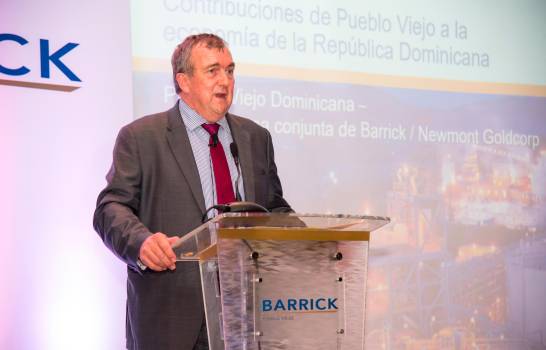
Energy & Mines Minister Antonio Isa Conde backs the announcement by Barrick Pueblo Viejo that it plans to invest US$1 billion to expand its operations in the Dominican Republic. Isa Conde stated that the extension of the mine’s useful life means more revenues for the government and for the socially responsible projects the company has underway in the community where it is located. He said the Ministry is working on a new legal framework to make this type of mining sustainable from a financial, economic and environmental point of view.
Canada’s Barrick Gold announced this week plans to expand its Pueblo Viejo operation in northeastern Sánchez Ramírez province. The company said that a feasibility study is underway for the expansion project in 2020. The mine is already one of the world’s “tier one” gold mines. A tier one mine produces 500,000 ounces of gold a year and has a projected life of more than 10 years.
Barrick Gold Pueblo Viejo is considering an expansion of the mine’s processing plant and tailings capacity with an estimated initial capital investment of more than US$1 billion and the potential to extend the life of the mine into the 2030s.
Source: DR1, DiarioLibre
June 3, 2019

Cardiologist Iván González Vidal is concerned that the recent increase in immigration from Colombia and Venezuela could have brought with it the Chagas disease (American trypanosomiasis) that causes severe heart damage. The condition is endemic in South and Central America.
The disease is caused by a parasite, carried by a bug, and it can be transmitted by oral contact, blood transfusions or via food. The condition can result in acute inflammatory skin changes (chagomas) and may eventually cause infection and inflammation of many other body tissues, especially those of the heart and intestinal tract.
Dr. González said that the damage is seen more frequently in young people. Dr. González says he has checked with the blood banks in the country, but none are testing for Chagas yet.
Source: DR1, Listindiario
June 3, 2019

Dominican teachers are failing big in teaching Dominican students to understand and love mathematics. The results of the evaluations carried out by the Ministry of Education (Minerd) reveal that the comprehension of mathematics is meager despite the doubling of government investment in public education over the past six years.
According to their studies, the number of students reaching a satisfactory level in math from the first grade to sixth grade is barely 4.1%. The 2017 assessment that was of first grade to third grade showed a 27% comprehension. It appears that as children advance, their mathematics skills decline.
The highest levels in comprehension registered by the assessment were of the Spanish Language with 27.37% of students reaching a satisfactory level. This was an improvement over the 12% of the students in first to third grade received in the 2017 evaluation.
Students tested with 15.63% reaching a satisfactory level in Natural Sciences.
Students at private elementary schools did better than students at public schools. At these, students from higher socio-economic groups outperformed students in lower socio-economic groups.
Students in extended school day programs slightly outperformed those who attended schools with classes just in the morning or the afternoon.
For the 2019 assessments, 159,000 students of sixth grade were tested, compared to 177,000 third graders that were tested in 2017. This includes public and private school students.
The Ministry of Education is hosting the 21st Central American and Caribbean Mathematics Olympiads this coming 14-22 June 2019.
Source: DR1,

Baseball-Reference.com, the obligatory baseball reference guide shows that 19, 519 persons, as of 25 May 2019, from 55 different countries (except Ed Porray who was born on the high seas in 1888), have played Major League Baseball. But Haiti, located between three major contributors of Major League players, had yet to export its first big leaguer.
All this come to the fore after Domingo German Polanco last week lit up the social media platforms when he told reporters that he was ‘also Haitian.” Turns out that Domingo German Polanco is the leading pitcher in the American League with nine victories. He is the star of the New York Yankees pitching staff.
A report in Diario Libre by Nathanael Perez Neró explains that because of prejudices and other social restraints it is unusual for a public person to refer to any Haitian lineage. (In Anthropology and History this is known as ‘subordinated popular culture’).
However, the list of Dominican-Haitian Major League Baseball players is actually a long one, with many real stars. Most of these players come from the areas around San Pedro de Macoris and La Romana, where the Haitian workforce in the cane fields was predominant for over a century.
Diario Libre explains that for instance, Tony “Cabeza” Fernández, known for his silky hands at the shortstop position, winner of four Gold Gloves and with five All-Star appearances, is perhaps the most outstanding representative of this group of players with a 45.3 WAR (Wins-Over-Replacement).
And there is the case of Alfonso Soriano, one of just eight Dominicans to hit more than 400 home runs, whose father is Haitian. He is officially Alfonso Guilleard Soriano, but his name was shortened in the American style to Alfonso Soriano, much like the Alou brothers whose real name is Rojas Alou).
Retired players Felix José and Esteban Yan have Haitian lineage. Also current players Miguel Angel (Jean) Sanó, currently the 3rd baseman for the Minnesota Twins, Felix Pie, Orlando Calixte, Wirfin Obispo, brothers Jandel and Emilio Gustave, Freddy Dolsi. The list also includes Vidal Brujan, who was the first choice in last year’s Dominican League draft and taken by the Toros of La Romana.
The Diario Libre feature explains that the mentioned ballplayers are just a sampling of those that were signed to play baseball. Sadly, there is another list of many, many more young men who could not be hired because they lacked the proper identification documents, such as a birth certificate or cédula. Take note that most Haitian migrants to the Dominican Republic cross over with no legal documentation as it is common to be undocumented in Haiti. Once in the Dominican Republic, some were not able to legalize their status in time to be recruited by the Major Leagues, and others didn’t get the best deals because of delays in the normalization.
For instance, the case of Calizto is typical. Born in Batey Lecheria in West Santo Domingo, he initially was offered a US$3 million dollar bonus in 2009, he eventually was able to get his papers in order and sign for US$1 million a year later by the Kansas City Royals. Calixte speaks fluent Kreyol, the native language in Haiti, and often shows both Haitian and Dominican flags on his social media sites.
Diario Libre reports that there are several promising prospects in the pipeline. Vidal Brujan is listed as the #64 prospect for all of the Major Leagues, according to Baseball America. There is speculation that Robert Puason, from La Romana of Haitian parents, could be offered a bonus of US$5 million.
Last July 2018, the Tampa Bay Rays paid a US$1.4 million bonus to the shortstop from San Pedro de Macoris, Alejandro Pie, their biggest bonus paid to an international player.
Lastly, there is Estevan Florial, who belongs to the New York Yankees and who is being marketed as the first Haitian to get into Major League Baseball. Although his passport says that he was born in Port-au-Prince, his parents say that he was born in southwestern Bahoruco, Dominican Republic, on the border with Haiti, as is stated in the Yankee press guide for 2018.
Source: DR1, DiarioLibre
June 3, 2019

Children have a new playground in Santo Domingo, the new Insectolandia Park at the Sambil Mall on Av. John F. Kennedy. The park will be open all throughout summer. The half an hour experience takes children to encounters with giant ants, bugs, and bees. There is a rotating tunnel, a selfie-zone, a magic house, an illusions house and more. The tour costs RD$250 for children from three years and more. Adults are RD$200.
Source: DR1, aplatanaonews
June 3, 2019

There have been recent stories of arrests made of men who have carried out several “express kidnappings” of a diverse group of people. As reported in El Dia, according to Josefina Reynoso, who directs the Center for Safety and Defense Studies at the Global Foundation for Democracy and Development (Funglode), the rapid and short-term kidnappings are seen around the globe and are prevalent in Latin America. Of course, they represent a threat to the Dominican Republic.
According to Reynoso, these kidnappings generally occur randomly, without any previous study or “casing” of the victim. In general, there is no following of the victim. An indication of wealth or money is what sparks action. For example, a fancy car, a nice watch, jewelry, a smartphone and so on.
She explains what the criminals are after is money and to get it fast. Often times they use the victim’s car to go to ATMs to withdraw money.
So, what can be done? In the first place, be wary, cautious at all times when out in public. Anyone can be a victim. When in your vehicle, try to have the windows up and the doors locked at all times.
Never remain in dark or deserted places, and if in a parking lot/garage, enter the vehicle quickly and lock up at once. Move out quickly.
As you go about your business and errands, do not leave anything of value-cell phones, laptops, or pocketbooks out in plain sight. Avoid walking alone in dark or deserted areas.
Always let your family in the know on where you are going and when you plan to be back.
Do not display anything that shows wealth: watches, glasses, cell phones, etc. try to use as few credit cards as possible and never show large amounts of cash. Be very cautious with strangers, and never reveal your location on social media. You should use taxis and Uber that are known to you.
The statistics show that most of these lightning-strike kidnappings occur at night and usually when the person is alone.
Always be very cautious if your car is bumped from behind, especially under normal conditions. Since the criminals are generally satisfied with your belongings and money from an ATM, do not try to disarm or make them nervous. Caution is the key word for everyone nowadays.
Two recent cases of the named express kidnappings were recently promptly resolved by the Police. These were the case of two young men in Evaristo Morales neighborhood who at around 3am were leaving a get-together at a friend’s house, and that of a young woman who boarded a supposed shared taxi where passenger and drivers were assailants. In both cases, young people were involved. The pattern seems to be to go after young people who are most likely to use bankcards that allow for quick cash access through ATM machines.
Source: DR1, Eldia
June 3, 2019