The Environment undertakes the cleaning of mangroves in Luperon Bay
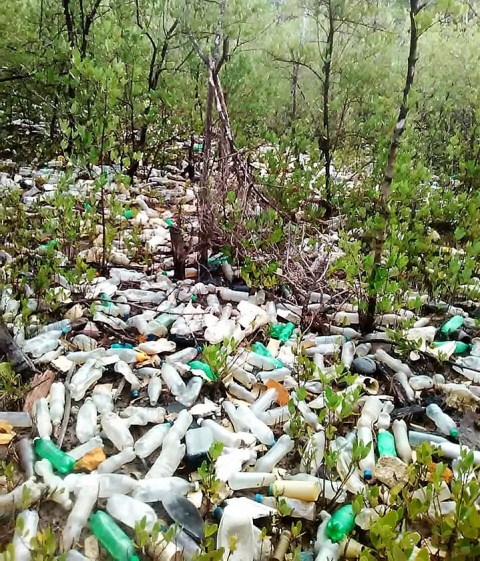
PUERTO PLATA.- Tonnes of solid waste are being collected in the mangroves that make up several ecosystems in the Wildlife Refuge of the Bahía de Gracia in the municipality of Luperón.
It is estimated that two thirds of the fish populations in the world depend on the mangrove, in one or more of their life cycles as they are also nesting and feeding areas for many species of birds and reptiles, their roots being the ideal substrate for many species of bivalves used commercially.
The sanitation day is carried out by the personnel of the Ministry of Environment and Natural Resources, who within the existing mangrove ecosystem there, with great zeal and enthusiasm, continue to remove bags full of garbage and waste.
In a mangrove area of 50 tasks that have been traversed, were extracted some 185 covers each with capacity of 55 gallons and 47 bags of inorganic waste, such as plastic and glass bottles, cups and plates of polyurethane, tin, in addition to plastic cases.
The solid waste that is being removed from the mangrove area in the beautiful Luperón Bay, is dragged by several ravines, which denotes the unbridled behavior of the society that lives on its back to its natural environment, without caring about the consequences of their actions.
The expert Pablo Rodríguez, explained that mangroves are the most important vegetation that predominates in the bay of Luperón, where the species are found: Rhizophora mangle (Red Mangrove), Laguncularia racemosa (White Mangrove), Conocarpus erectus (Mangle Button) and Avicennia germinans (Black Mangle).
“The mangrove ecosystem of which there are around 258 square kilometers in the Dominican Republic is economically important, since it represents a source of food for most of the estuarine and marine organisms that live there,” Rodríguez said.
He said that the mangrove ecosystem is characterized by high productivity, production of organic matter, barrier against coastal erosion, natural barrier against salinity and waves, help improve water quality, fixation of pollutants.
Source: Puerto Plata Digital
Oct 11, 2018
Category: DR News |