Archive for April, 2018
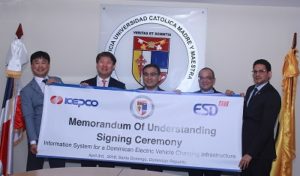
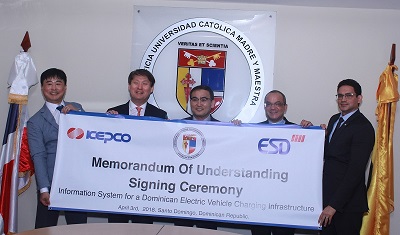
The South Korea state-run Korea Electric Corporation (Kepco) continues to back a national effort to install electric vehicle charging stations in the Dominican Republic, a project that is valued at US$30 million. Kepco, in November 2017, signed a memorandum of understanding with the National Energy Commission (CNE). Another step forward to advance the project was taken on 2 April 2018, with the signing of an agreement to conduct electric vehicle infrastructure research and development in the country, led by a consortium of companies and universities. The consortium is led by PUCMM University, the largest Dominican private university, and ESD Engineering.
PUCMM has accepted the challenge to design an electric vehicle charging infrastructure operation system in the Dominican Republic based on international standards. Signing were Han Sang-kyu for Kepco, University rector Alfredo de la Cruz Baldera for the PUCMM and Sang Min Choi for ESD Engineering & Service.
In the PUCMM project, the Korea International Cooperation Agency (KOICA) is providing US$300,000 while the Kepco will share its EV charging infrastructure operation techniques to local companies and the university.
The system to be developed in the project will become the standard for the Dominican Republic. South Korean companies in the industry are expected to be able to get the upper hand in the country’s future projects for EV charging infrastructure construction.
At its widest point, the Dominican Republic is 265 kilometers, which means it is reachable with a fully charged vehicle. Kepco has said it intends to install 160 EV charging stations in three cities while collaborating with local communities in the renewable energy sector.
This is Kepco’s second EV infrastructure project in Latin America. The first was in Ecuador.
Source: DR1, investigacion.pucmm.edu.do
April 10, 2018
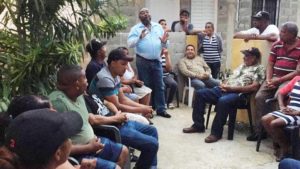
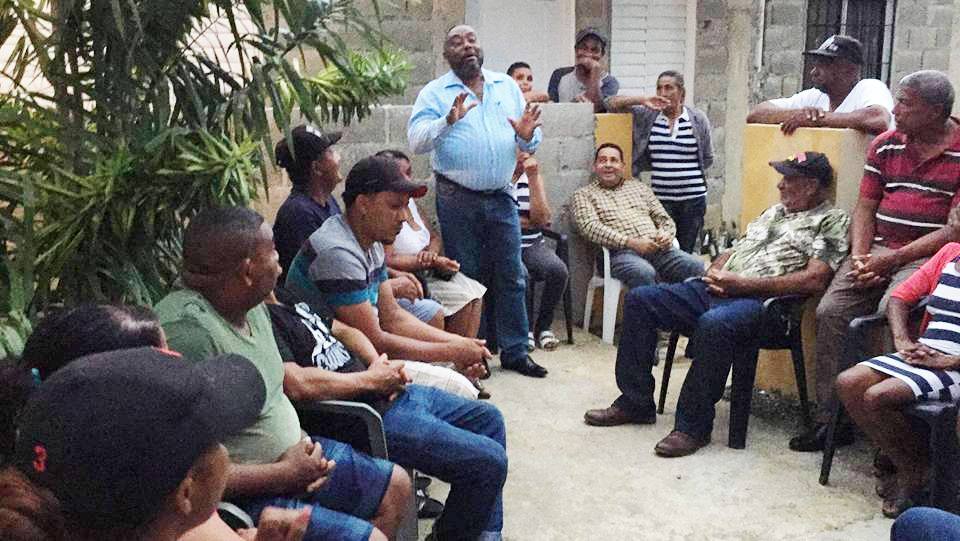
Thursday afternoon, April 5th, residents of Los Castillos (Sosúa) held a protest meeting. The residents are outraged about the monthly water bills the water company CORAAPLATA sends them. Although the water supply leaves a lot to be desired, they often don’t have any water for days, but the bills remain equally high. So the residents have to pay for water they never received. At the meeting the residents decided to form a delegation to go to Puerto Plata to present their grieves to the management of the water company. It has been proposed to remove the water meters and then return them to the water company. They also require that bills be reduced because of the lack of water supply. They also want an improvement on the water supply.
Source: Sosua News
April 10, 2018
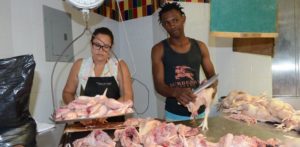
Supermarkets, restaurants, and local “pica pollo” establishments are having a lot of trouble with their supply of poultry both in Santo Domingo and in the rest of the country, apparently because the poultry producers reduced their stocks by some 30% and now fresh killed chickens are selling for RD $65 and RD $70 per pound. Representatives from different sectors that consume poultry products complained that the producers are rationing their supplies by as much as 30% and the gondolas in many supermarkets are sometimes nearly empty. Regarding housewives, the lack of poultry requires them to find other alternatives to chicken, which is the least expensive meat in the Dominican diet.
Dionisio Quinones, the secretary-general of the National Union of Economic Supermarkets, said that their supply has been reduced by between 25% and 30%. One area manager at a Plaza Lama said that they ask for 500 pounds a day of poultry and are barely receiving 100. The owner of a small restaurant on Independence Avenue, Altagracia Paniagua, said that she has had to work miracles in order to obtain a small amount of poultry for her clients. She said that at 8 o’clock in the morning none of her usual suppliers had any chickens left. As a result of the scarcity of poultry in the local market, other products such as eggplant, beef and pork are going up in price.
Source: Dr1, Elnacional
April 8, 2018
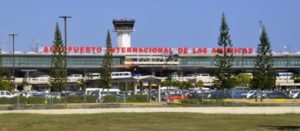
More than 250,000 Dominicans have active travel restriction cases against them that theoretically prevent those affected from leaving the Dominican Republic. There are also some 14,000 foreign residents, mostly Europeans, who are not allowed to leave the national territory because of different judicial proceedings against them.
Sources at the office of the Attorney General of the Republic and at the Directorate General of Migration revealed that the foreigners with travel restrictions include Spaniards, French, Germans, Italians, Chinese, Americans, and several other nationalities and are generally involved in outstanding judicial cases regarding property, real estate, physical aggression and child support issues.
The travel restrictions for Dominicans are usually requested by judges and prosecutors and are set forth by the Attorney General of the Republic and notified through officials at Migration.
According to the reports relating to Dominicans, most travel restrictions are related to open cases of crime, including accusations of sexual harassment, corruption, falsification of documents, human trafficking, drugs, traffic accidents, and other issues.
Sources revealed that there are travel restrictions in force as far back as 20 years ago and for reasons which for the most part have disappeared but still remain on the books and in the archives both at the Attorney General’s office as well as at the offices of Migration.
Among those Dominicans who cannot travel are former officials, former mayors and city council members active and retired members of the top military and police commands, former diplomats, active and former baseball players, businessmen, bankers and others. According to the report many of the persons with travel restrictions have made numerous attempts before the judicial authorities to petition the lifting of the disposition, often with no positive results.
Source: DR1, Elnacional
April 8, 2018
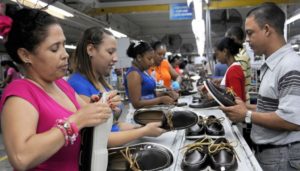
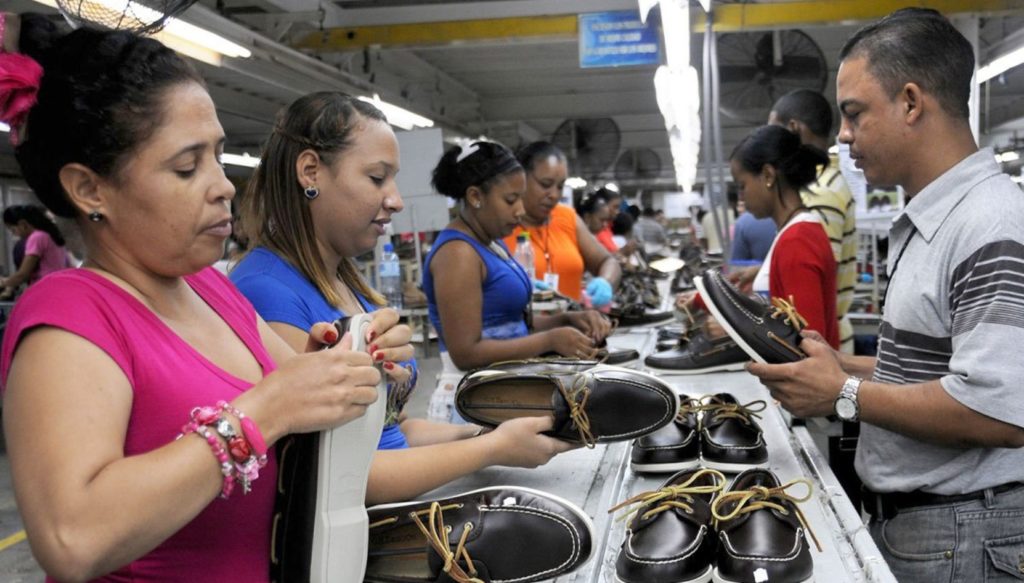
The Dominican Republic can create 350,000 new jobs in three years if new policies are put in place to enhance the competitiveness of tourism, footwear, medical devices, pharmaceuticals, electrical and electronic devices and call centers, five sectors with great export potential identified by the Association of Industries of the Dominican Republic (AIRD). AIRD sees potential to increase exports by US$2.7 billion a year.
The potential for the tourism sector is estimated at US$4.6 billion through 2021 with the potential to create 183,000 new jobs. The tourism sector has generous tax incentives.
Medical devices manufacturing, that operates in tax free zones, could generate US$3.2 billion in exports and create 47,000 jobs. The electric and electronic deices sector (also operating in tax free zones) could contribute through 2021 US$2.7 billion and create 32,000 new jobs. Meanwhile, call centers have the potential to generate US$1.2 billion and create 53,000 jobs. Footwear is estimated to generate 37,000 new jobs and US$1 billion in exports.
Circe Almanzar, executive vice president of AIRD, says to achieve these objectives of exports and jobs, beyond the present focus on tax incentives, better supplier policies are needed for savings in logistics and strengthening of the local market. Almanzar said that this means the government needs a change in vision to enact policies that support the industries, and not necessarily through tax incentives. “To grow public policies are needed, and we have a vacuum of public policies directed to these sectors,” she said. AIRD advocates for a public private alliance to achieve competitiveness.
The president of the Association of Industries de Herrera and province of Santo Domingo, Antonio Taveras Guzmán corroborates that changes to the development model are needed. “We need a strong state but a smaller government,” he said. He urged efforts begin to promote the true development of large, medium-sized, small and micro Dominican industries. “The country needs a real commitment, to leave politicking aside, to face the challenges industry confronts,” he said.
Source: DR1, Eldia
April 8, 2018
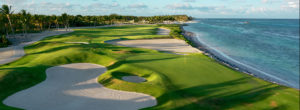
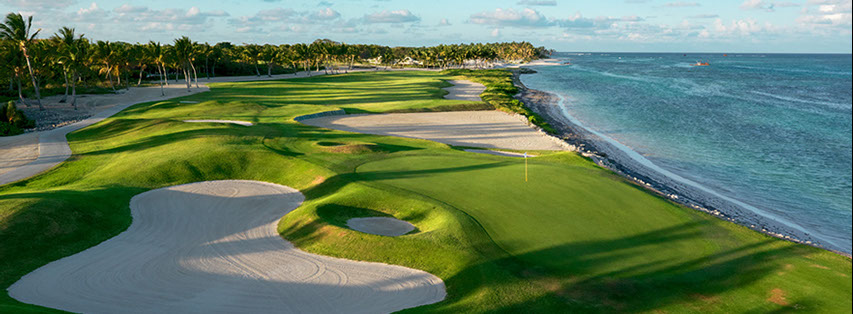
There was a time when the Dominican Republic was best known for its intoxicating cocktail of salsa and merengue, and for producing Major League Baseball legends such as Sammy Sosa and Big Papi. In recent years, however, this Spanish-speaking nation of powdery coastlines and lush sugar cane fields has emerged as a golfing Mecca. With 26 golf courses and the top ranked course in the Caribbean, the Dominican Republic is where American golfers head for a round in paradise, just two hours from Miami.
The country’s first luxury course was at Casa de Campo, hewn out the rock by 300 workmen with sledgehammers and picks in 1971. The Teeth of the Dog course, designed by Pete Dye of Sawgrass and Kiawah island legend, has 7 holes along the coast, with the par-three 5th hole on its own peninsula, resembling the snapping jaws of a dog against the encroaching ocean waves. Dye famously said that 7 of the course’s holes were created by God and he only had to come up with the other 11. Today, it has been ranked as the 43rd best course in the world.
The exclusive Casa de Campo resort was built by sugar barons, and hosts a Who’s Who of the Dominican Republic’s most famous visitors, including White House, Wall Street and Hollywood. The resort has two other Dye courses: The Links and Dye Fore. Tee times can be booked by resort guests for around $185, while non hotel guests pay just $250 for a round. Famous names to take on the greens include George H.W. Bush, Nick Faldo and Michael Jordan.
The resort of Cap Cana on the country’s eastern tip is served by nearby Punta Cana airport, with 38 airlines from 100 cities, and has been billed as “the world’s next luxury destination.” Punta Cana resort has three championship golf courses.
Tom Fazio-designed Corales Golf Club opened in 2009 and has six holes at the water’s edge, with inland lakes and coralina quarries. The last three holes form the ominously entitled Devil’s Elbow along the natural cliffs.
La Cana course has 27 holes incorporating three nines, designed by P.B. Dye. The environmentally-friendly course is the first in the Caribbean to use paspalum grass which can be watered with sea water. Golf Magazine called this the number one course in the Caribbean and compared it to Pebble Beach.
Also at Cap Cana, Punta Espada opened in 2006 and is the first of three Jack Nicklaus courses to be slated for Cap Cana. Golf Week quickly voted it the top course in the Caribbean and Mexico and it has hosted a televised PGA tour event, won by Fred Couples in 2010. The course has 8 holes along the water’s edge.
Playa Grande at Rio San Juan was one of the last courses Robert Trent Jones Jr. designed before he passed away. Set on 370 acres of coastline, the course has 10 holes on the waterfront, but is currently under renovation until 2014, with just nine holes currently playable.
Source: BellaOnline.com
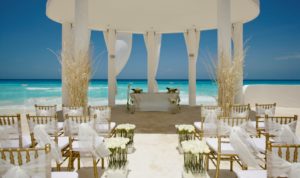
Hoping for the perfect Caribbean wedding and honeymoon? Then the Dominican Republic is an excellent choice, because local hotels really know how to pamper the bride and groom-to-be and make sure every single detail of this event is well taken care of.
Weddings in local hotels are stress free, because the bride and groom are considered guests at their own wedding. All hotels offer wedding packages and have the right personnel to organize the event, depending on the needs of the couple. Legal assistance is also provided.
The Dominican Republic hotel facilities know how to pamper the bride and groom that have chosen their particular facility to celebrate their wedding.
Although some couples do get marry in the country, others prefer to get married in their particular country and then hold the ceremony in the Dominican Republic.
There are hotels and facilities for all budgets and particular needs.
While some couples may prefer to hold their wedding at an all-inclusive resort, others prefer to celebrate this important event in small boutique hotels, where the wedding celebration will be intimate and elegant.
The following list will provide pertinent information on the best hotels to hold weddings based on ambience, quality of service, special attention to the couple, and comfortable facilities.
Casa Colonial Beach & Spa
In Puerto Plata, the north coast’s most important city, the 50-suite “Casa Colonial Beach & Spa” is considered by many to be the best hotel in this particular region.
A member of Small Luxury Brand Hotels of the World, the facility offers a very intimate and romantic setting, the ideal location for the perfect Caribbean wedding, and the idyllic getaway for couples and honeymooners.
The hotel has a special wedding pavilion, with breathtaking views to the nearby beach which serves as a natural backdrop to the ceremony (www.casacolonialhotel.com).
Casa Bonita
Situated atop a hill that provides stunning views of the Caribbean Sea, a nearby mountain range and rivers, Casa Bonita is truly a magical place.
This 12-room hotel boutique provides the wedding couple with a romantic and intimate setting to celebrate their wedding party. Casa Bonita is a member of the Small Luxury Hotel of the World (www.casabonitadr.com).
Grand Palladium Punta Cana Resort & Spa
This particular resort features several all-inclusive hotels within the complex, including the adults-only 372-room luxury facility Royal Suites Turquesa.
The resort offers various wedding packages or an individual wedding planner that will help the couple plan their very particular event.
Packages offered range in price from US$1,615 to US$4,665 (from eight to 14 guests, and US$22 per additional guest (www.grandpalladiumpuntacanaresort.com).
Barcelo Bavaro Beach Resort
The Barcelo Bavaro Beach Resort complex features a wide variety of locations and wedding planners to help put together that special Caribbean wedding. Wedding parties can be celebrated in the resort’s lush gardens, in a spectacular oceanfront gazebo, or on the beach itself.
The resort also features a beautiful Catholic church, where the altar features a special painting of the nearby lake where the church was built. The bride and groom can plan their particular event, or select the resort-package that better fits their budget and needs.
Packages range from a free-of-charge wedding party if the wedding party reserves 25 rooms, to more expensive options (www.barceloweddings.com).
Casa de Campo
This exclusive resort promises “A wedding in Paradise,” no matter if it’s a small event or an extravagant wedding party for hundreds of guests. Expert wedding planners will take care of the smallest details.
Packages range from US$495 to US$1,405. Reception costs range from US$172 to US$261 per person (plus tax) (www.casadecampo.com.do).
Tortuga Bay
This facility provides the perfect setting for that special Caribbean wedding.
The beautiful nearby beach is the backdrop for the wedding ceremony.
It is a small and intimate setting, with 13 beachfront villas, all designed by famed Dominican-American designer Oscar de la Renta (www.puntacana.com).
The Bannister Hotel
This 31-room luxury facility, a member of the Small Luxury Hotels of the World, offers breathtaking views of the nearby Puerto Bahia marina.
The marina is surrounded by quaint squares and lush gardens is truly a paradisiac environment for that perfect wedding (www.thebannisterhotel.com).
Majestic Elegance
The 597-room Majestic Elegance Hotel offers various settings for weddings. The hotel can coordinate weddings presided by a judge or a priest.
Wedding packages include the wedding cake, decorations, ironing of dresses and suits, flower arrangements and a champagne toast for the newlywed couple.
It is also a perfect destination for honeymooners (www.majestic-resort.com).
Sublime Samana
Situated in the north coast fishing village of Las Terrenas, the Sublime Samana is the perfect facility for a small intimate wedding.
The facility is also a member of Small Luxury Hotels of the World (www.sublimesamana.com).
Excellence Punta Cana
This particular hotel (all-inclusive, 522 rooms) lives up to its name when it comes to a wedding celebration. It is the ideal spot for that perfect romantic wedding ceremony. A wedding planner will handle all the details of this important event, including securing the judge, priest or pastor that will perform the ceremony, decorations, wedding cake, flower arrangements, and many other amenities.
On the wedding day, the bride is taken on a horse-drawn carriage to the wedding gazebo, where guests are waiting for the arrival of the wedding party (www.excellence – resorts.com).
The Peninsula House
It is a cozy and intimate Victorian home with 6 rooms dating back to the eighteenth century. It Is ideal for an elegant and romantic dream wedding and memorable honeymoon. Add the ambiance of tropical gardens which overlook a pristine beach, and the luxury residence designed by French architect Serge Robi, then you will know why this facility has been included among the top 100 boutique hotels in the world, according to the 2013 Gold List of the journal Condé Nast Traveler (www.thepeninsulahouse.com).
Zoetry Agua
Its relaxed luxury ambience provides the perfect environment for couples. Its facilities are excellent for wedding parties. Wedding planners handle all details, to guarantee the perfect wedding celebration (www.zoetryresorts.com).
Iberostar Grand Hotel Bavaro
This 272-room, all-inclusive, adults-only, facility is the perfect destination for couples, and is highly recommended for wedding celebrations or honeymoons. All wedding details are expertly handled by the hotel’s wedding planners (www.iberostargrandbavaro.com).
Paradisus Palma Real Golf & Spa Resort
The all-inclusive resort provides the wedding couple with an excellent team of wedding planners.
Its beachfront gazebo provides a sense of intimacy and elegance for a romantic wedding celebration (www.melia.com).
Marriage Requirements in the Dominican Republic:
• Birth certificates of the bride and groom
• Legalized document stating that both the bride and groom are single. If divorced, the wedding must take place ten months from the date of the divorce.
• Photocopy of the passports (or other documents used to enter the country).
• Photocopy of the passports of the witnesses who are not relatives.
• Documents must be authenticated by the nearest Dominican Consulate.
• The documents must be translated into Spanish law by a legal interpreter in the Dominican Consulate, or in the Dominican Republic.
• Two witnesses (not family members).
• For more information: www.domrep.org/gettingmarried.html.
Source: Access DR
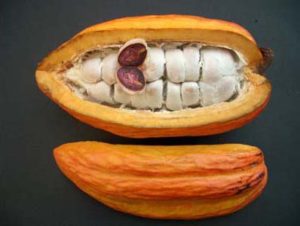
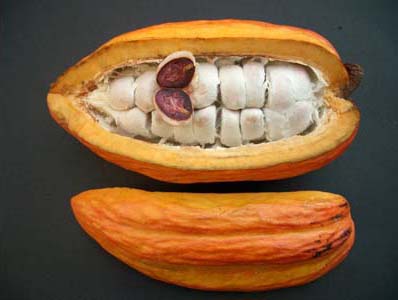
In one of life’s not-so-small miracles, chocolate really does grow on trees. And in the rainy hills of the Dominican Republic, this is especially true. Serious Sweets recently ventured to this lush island with French chocolatier Valrhona for a tour of their partner farms and a crash course in the DR cacao landscape.
Chocolatiers like Valrhona are looking to this Caribbean nation not only for the chocolate flavors it can produce—think classic notes of yellow fruit and bright acidity—but to the great potential that exists here for cooperating with farmers and exploring agricultural experiments. And though Valrhona works as directly as possible with cacao producers around the world, there are a few specific farms, such as El Pedregal in Venezuela, and Loma Sotavento in The Dominican Republic, that they’ve actually bought a stake in. These partnerships allow Valhrona to use the farms as living agricultural laboratories for the earliest stages of the cacao-to-chocolate process—they’re as much farms as they are experimental sandboxes for agronomists and, literally, tastemakers.
We visited Loma Sotavento, a farm in the northeastern region of Maria Trinidad Sanchez, to see one of these farmlabs firsthand. From the vibrant gold-to-red spectrum of ripe cacao pods to the surrounding community of farming families and the cultivation of other plants complementary to cacao production like banana and cassava, this region felt rich and abundant in many ways. Modestly scaled at only 20 hectares, the 300 meter-altitude Loma Sotavento made an ideal setup for education and experimentation—just so long as one was careful not to slide down the muddy hillside.
As global cocoa production goes, Valrhona is a comparatively small player. The rest of the cacao world is making chocolate chips and other low-grade chocolate items that don’t require a tremendously high bar in the way of quality. Likewise, much of the cocoa grown in the Dominican Republic is relegated to the moniker of so-called “Sanchez” cocoa: commodity-grade chocolate suitable for cheap candy, store-brand cookies, and the like. Working alongside its local cocoa partner Rizek, Valrhona saw not just an opportunity to cultivate another unique flavor profile in its single origin estate category, but a chance to develop a better understanding and increase the potential of chocolate products derived from these leafy Caribbean slopes.
And like many outside producers investing in direct relationships with farms at the origin level (this notably also happens in coffee, where the chain of agriculture and production is quite similar to cacao), Valrhona is looking at their DR setup as a biodiverse model they hope to apply to other regions. They’re focusing on organic cultivation that’s absent of chemical pesticides or fertilizers. When grown in the shade of other fruits and trees, the cacao is said to produce flavors that evoke the various fruits planted around it, creating a signature terroir that is also natural.
After actual cultivation, growth, and drying of the beans, the biggest farm-level factor affecting chocolate flavor is fermentation. At Loma Sotavento, experimental, time-staged fermentation boxes allow cacao beans to oxidize and ferment at different rates—in this example, the boxes were staged at two, four, and six days’ fermentation time—which will then produce different flavors once roasted and produced into chocolate. Valrhona’s agronomists are after the answers to questions like, what is the relationship between acidity and fermentation time? What about moisture content? The proving ground at this farm, and their other experimental relationship farms, allow them to attenuate all of these factors to get closer to the answers—and flavor profiles—they’re seeking.
From the fermentation stage, the cacao beans are then sent overseas to France, travelling overseas in a two to three week journey. The beans are then roasted and produced into chocolate, and tasted by Valrhona’s tasting committees, which consist of a minimum of ten people and can be up to twenty-five. It is this committee of palates and cacao roasters that ultimately bring out what the chocolatier has decided to express in any particular chocolate. In the case of this particular farm, the Grand Cru de Terroir chocolate they’ve named Taïnori for the indigenous Taïno peoples is a subtle, 64% dark mix of yellow stonefruit and nutty notes, with a warm finish. (A second Dominican Republic chocolate, the Bahibe Lactée, was released as well.)
Source: http://sweets.seriouseats.com
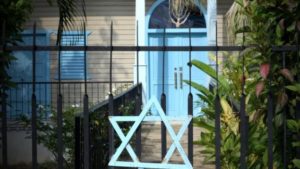
SOSUA, Dominican Republic – With its bamboo roof and breezy open air design, Bailey’s Cafe near the far end of Dr. Joseph Rosen Street is the perfect place to take refuge from the scorching afternoon Dominican sun.
As soon as we are seated, a waiter heads toward us with two cups of Santo Domingo, the locally produced coffee. Joe Benjamin, 73, pours two sugar packets into his rich, dark cup of coffee and gathers his thoughts; his memories are as bittersweet as his coffee.
“What we were, the community that was here, it was unique. It was special, but it’s in the past. The next generation will know us as a chapter in a history book,” says Benjamin. He takes a sip of coffee, and adds a quick, “And that’s ok.”
Benjamin came to Sosua, now a town of some seventy thousand people on the north shore of the Dominican Republic, with his parents in 1947 via Shanghai.
Originally from Beslau in Silesia, the Benjamins were among 800 recipients of visas issued by the Dominican government in the 1940s to come to this impoverished island to work the land and develop its lagging agricultural system.
Earlier this year, Sosuans marked the 75th anniversary of the Evian Conference, sponsored by US President Franklin D. Roosevelt to facilitate the resettlement of political refugees (in other words Jews) once the Nazi’s racial laws worsened the humanitarian condition in Europe. By 1938, discriminatory practices in Germany and Austria had given way to violent intimidation and sparked a refugee crisis.
The conference has been called, to paraphrase the Roman historian Sallust, “honest in face but shameful in heart.” Western Democracies across the globe shut their doors to Jews seeking asylum from the Nazi terrors in Europe, despite public expressions of sympathy by their governments at the horrors they were undergoing.
The United Kingdom, according to one diplomat present at Evian, declared that his island was “not a country of immigration,” and was “already sufficiently populated.” British colonies were deemed “inappropriate” for settlement, and Palestine at the time was off the table due to “local and political considerations [which] hinder or prevent any significant immigration,” according to “Dominican Haven” by Marion A. Kaplan.
France declared it had already reached its point of “saturation” regarding immigrants. Australians explained that because theirs was a relatively young country, they did not have a race problem and “were not desirous of introducing one.”
Industrial powers Canada and the United States, as well as needy developing countries Argentina and Brazil, found crafty reasons to not accept any refugees, despite expressing moral outrage at the situation. Some countries toyed with the idea of accepting refugees who were strictly “agriculturists,” but that too never went further than conjecture.
The most germane observation regarding Evian came from Holocaust historian Henry Feingold, who lamented, “Representatives of the Jewish organizations despaired, as hope for immediate actions was drowned in a sea of Latin eloquence.”
Enter one of the more unsavory and insidious figures of the 20th century.
The hero of Evian was not the revered Roosevelt, whose wife would come to be known as one of the greatest humanitarians of her time, but rather Generalissimo Rafael Trujillo, who ruled the Dominican Republic from 1930 to1961. Here was a man regarded by the rest of the world as an impersonal and violent dictator whose good deeds were fueled more by opportunism than statesmanship.
While Trujillo offered to absorb 100,000 refugees, only 800 received visas between 1940 and 1945. But neither the numbers, nor his politics, mattered much to the Jews who settled in Sosua. The Jewish community didn’t get involved in politics, Benjamin explains: “Whatever Trujillo was, [if] you asked the Jews, for us he was a savior.”
Denny Hertzberg, 75, grew up in Sosua and worked for the government overseeing industries formerly owned by Trujillo until the dictator’s death by assassination in 1961. He agrees with his old friend Joe Benjamin.
“Looking back, saving one Jew is one more Jew who would not have been sent to the gas chambers. Many more could have been saved,” says Hertzberg.
On a cold gray afternoon in 1940, Dezider Scheer sat on the docks of a shipyard in Brindisi, Italy, gazing out toward the empty Adriatic Sea, desperately searching the horizon for signs of the Greek ship that would sail him to a better tomorrow.
He describes that moment as the loneliest in his life: His eldest brother had made arrangements for him to get to Palestine through the Czech underground, but as the day turned to night, it became clear the boat was not coming and he was out of options.
It would have seemed inconceivable to him in those despondent war-torn days in Brindisi that a few months later he would be enjoying the smiles of 100 schoolchildren, all under his care as schoolmaster, playing gleefully in the tropical sun. He eventually met some fellow Slovaks who were hiding out in the upper story of a brothel near the port. That’s where the representatives from the Dominican Republic Settlement Agency (DORSA) found them.
“It was a paradise for us,” he says about the early days in Dominican Republic in a remorseful and apologetic tone as we share tea and cake. “We didn’t know what was going on Europe. We stopped thinking about it. We were living in a paradise, and they were dying in that hell Auschwitz. Peres, Ben-Gurion, they would have been proud of us. We were farming, planting, building. But what did my brothers think about it, that I was here enjoying my life?”
The life that was created in the Dominican Republic has come to be known as “Tropical Zion.”
While Jewish communities in Europe disappeared into the gas chambers of Poland, the Jews in Sosua lived a rich, cultural, Jewish life, completely removed from what was happening to their families and friends in Europe. Life, almost exactly as they had known it before the Nazis came to power, continued.
“We had a Jewish education class once a week, given by Dr. Rubcheck. Coincidentally, it was taught in German,” Benjamin says. “There were Germans who were told to leave [Germany] because of their Judaism. Here they still did very German things, but we were also all in the synagogue on Friday night and on holidays. Even Israeli holidays after 1948.”
But the Jews of Sosua were not the only ones enjoying the German culture brought over from Europe to the Caribbean. Many non-Jewish Germans began immigrating to Sosua in the late forties and early fifties, seeking a better climate and opportunities not yet available in early Marshall Plan Germany.
“They were real-working class Germans, not sophisticated types. They didn’t know us and they didn’t know Hitler. They were just grateful to find a German speaking community with theater and music and so on. They weren’t apologetic, but they weren’t indifferent either,” says Benjamin.
Those Germans, and their children, are still here on semi-retirement, spending their days in the cafes and cigar shops that line the main street. But today, unlike the early days of the settlement, the Germans outnumber the Jews by a wide margin.
Jewish life is fading fast in Sosua. Much of the community has left for Florida, where the standard of living is far better. The most visible members of the Jewish community in Sosua today are locals who have converted to Judaism in the past decade.
Rabbi Ancel Solomon flies in from Toronto to spend half the year here, and tends to the Jews in the area. His biggest undertaking is protecting his flock from the well-financed Jews for Jesus church on the opposite end of town. Solomon will also perform the rare circumcision or tropical destination wedding.
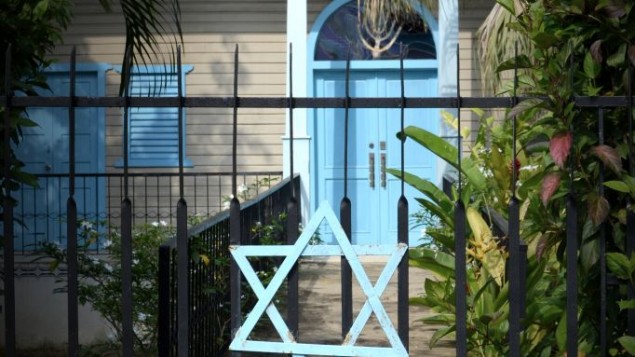
While there are services every Friday night in the original town synagogue, there is rarely a minyan and the cantor is an Italian doctor who lives on the opposite end of the island and manages to come and lead the congregation sporadically. None of the remaining original members of the community attends services.
With me at shul on Friday night is an American couple on vacation from Ohio, the cantor and his wife, the rabbi, and a few walk-ins.
Hertzberg laments the loss of European ambiance. Leaving services on Friday night, when the sun is comfortably out of sight, the changes in Sosua become most apparent.
The cultural life so dear to Hertzberg has given way to the predictable underbelly tied to a thriving tourism industry, and Sousa has become a typical Dominican town.
There has also been a large migration of Haitians to the north shore of the island following their devastating earthquake in 2010. (Even though the two countries share the same island, the Dominican Republic was largely unaffected.)
Many on the poorer north shore of the island are trying to make money by any means necessary so they can send something back to support their families, which has caused the growth of two of Sosua’s more profitable side businesses: sex tourism and drug trade.
Back in Benjamin’s day, on a Friday night it would have been commonplace to see families to walk down Dr. Joseph Rosen Street arm in arm, singing and full of good humor. Today upon exiting the synagogue and walking down the street, those seen locked arm in arm are mostly middle-aged white men, or a few college age kids, headed to a quiet room with exotic prostitutes.
The homes that once belonged to the settlers which lined the main road, the last of which belonged to Luis Hess who died last year at the age of 100, have been converted into overcrowded bars and sweaty discotheques. Gangs of motorcyclists man their assigned intersections, peddling everything from cocaine to Viagra.
Herzberg is unimpressed at what his boyhood home has become. “The good old days are in memory only.”
Source: Timesofisrael.com
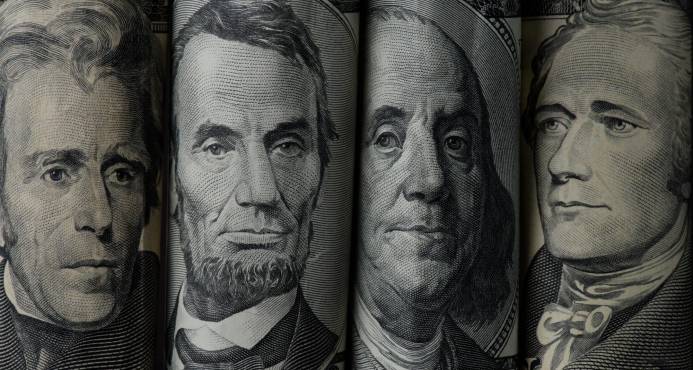
According to the Central Bank, the rate of depreciation of the peso has accelerated at the closing of the first quarter of the year, estimated at 2.07%. On the last working day of March, the 28th, the United States dollar was at RD$49.3001, whereas the previous year closed at RD$48.2993 for each dollar.
Over the last 12 months the rate of devaluation of the peso to the American dollar has been at 4.1% but the major part has been this year, with deprecation at 1.39% over the first quarter.
The reason, according to economists, is that the Banks are not selling a high amount of dollars and there is not sufficient US currency circulating to meet the demand of businesses.
According to government sources, businesses and lenders in the Dominican economy are holding on to US dollars for speculative reasons and that this has led to increased pressure on the peso.
But the tensions surrounding the exchange rate are not just related to foreign currency as the net international reserves were at US$8.05 billion at the end of February 2018 which is the highest amount of savings in dollars which the country has ever seen.
Source: DR1, DiarioLibre
April 4, 2018